- No words yet. Type or tap a letter to start.
Blossom Word Game
Every day, you get seven letters arranged on a flower-shaped puzzle. One letter sits in the middle. Make as many words as you can, and every word must use that middle letter. Blossom Word Game is free, and it’s spelled the British way, so colour, favourite and neighbour all count as correct. There’s nothing to download and no account to make.
How to Play Blossom Game
- Look at the flower. One letter sits in the centre, and six more sit on the petals.
- Make words that use the centre letter. Every word needs it.
- Use only the seven letters. You can repeat any of them inside a word.
- Tap or type your letters, then press Enter.
- Hunt for the pangram, a word that uses all seven letters.
Words need at least three letters, and there is no cap on how many you can submit.
How Scoring Works in Blossom Word Game
From three-letter words to the elusive pangram, here’s exactly how points, ranks and British spelling shape every hive.
How scoring works
| Word length | Points |
|---|---|
| 3 letters | 1 point (flat) |
| 4 letters or more | 1 point per letter |
| Pangram (all 7 letters) | Word’s length score + 7 bonus |
Three-letter words are worth exactly one point no matter which letters they use, but don’t write them off. More than a third of your available points on a typical day sit in three-letter words, so skipping them costs you more than it looks like at first glance. A seven-letter pangram, by contrast, is worth 14 points on its own.
Rank ladder: Seed to Botanist
Your rank depends on the share of that day’s maximum possible score, not a fixed number. Some hives simply hold more words than others, so the ladder scales with the puzzle instead of punishing you for a smaller word list.
| Rank | Share of max score | 90-point puzzle | 150-point puzzle |
|---|---|---|---|
| Seed | 0% | 0 | 0 |
| Sprout | 5% | 5 | 8 |
| Bud | 12% | 11 | 18 |
| Growing | 22% | 20 | 33 |
| Bloom | 35% | 32 | 53 |
| Full Bloom | 50% | 45 | 75 |
| Garden | 65% | 59 | 98 |
| Bouquet | 80% | 72 | 120 |
| Botanist | 100% | 90 | 150 |
Reaching Bloom or Full Bloom is a solid result on most days. Botanist means you have found every valid word in that day’s blossom.
By the numbers
We looked at a full batch of our own puzzles to see what a typical day actually looks like:
| Measure | Finding |
|---|---|
| Words per puzzle | Ranges from 18 to 45, averaging 37 |
| Share of words that are 3 letters | About a third |
| Average word length | 4.4 letters |
| Puzzles with more than one pangram | About 1 in 5 days |
| Most frequent centre letters | Y, C, W, V, X |
A centre letter like Y, C or W shows up more often than you’d expect from everyday spelling. That’s because the puzzle only uses a centre letter that can support a full board of words, not just a common one. If your centre letter looks unusual, that’s normal, and it’s usually a sign the puzzle has more hiding in it than it first appears.
Where the word list comes from
The word bank is built from real English usage data, checked against a standard dictionary and filtered to remove proper nouns and brand names. That’s different from pulling straight from a Scrabble-style word list, and it means the words you’re asked to find are ones people actually use, rather than obscure entries that only a dictionary would recognise.
Why this puzzle uses British spelling
Merriam-Webster is an American publisher, and players report that its Blossom game rejects many British spellings, such as colour and flavour. This puzzle uses British English instead, which changes which words fit a hive and, sometimes, which hive can make a pangram.
Short finds: cold, code, core, lore, order, older
Longer finds: colder, louder, record, cloud, could, colour
The pangram: coloured
American spelling drops the U, so “colored” would miss a letter and fail as a pangram. This hive only works with the British spelling.
Six spelling patterns that find extra words
-our endings
colour, favour, honour, harbour, neighbour
-re endings
centre, metre, litre, theatre, fibre
-ce nouns
defence, offence, and licence (the noun) — its verb is “license,” also valid
Doubled L before endings
travelled, labelled, cancelled, modelled
Extra letters
programme, catalogue, cheque, grille
ae and oe
anaemia, manoeuvre, encyclopaedia
Both -ise and -ize appear in words like organise and organize, so try both. Then look for everyday words such as lorry, biscuit, jumper, tyre, kerb, plough, and grey.
Blossom game, Spelling Bee and Countdown
Word puzzle fans often know Countdown, first shown on Channel 4 on 2 November 1982. Its letters round gives contestants nine letters and 30 seconds to find the longest word. Blossom flips this: fewer letters, no clock, and a centre letter that every word must use.
Blossom sits in the same family as the NYT Spelling Bee and Merriam-Webster’s own Blossom, but each sets its own rules:
| Puzzle | Word limit | Shortest word | Pangram bonus |
|---|---|---|---|
| This Blossom Word Game | None | 3 letters | Flat +7 |
| NYT Spelling Bee | None | 4 letters | +7 |
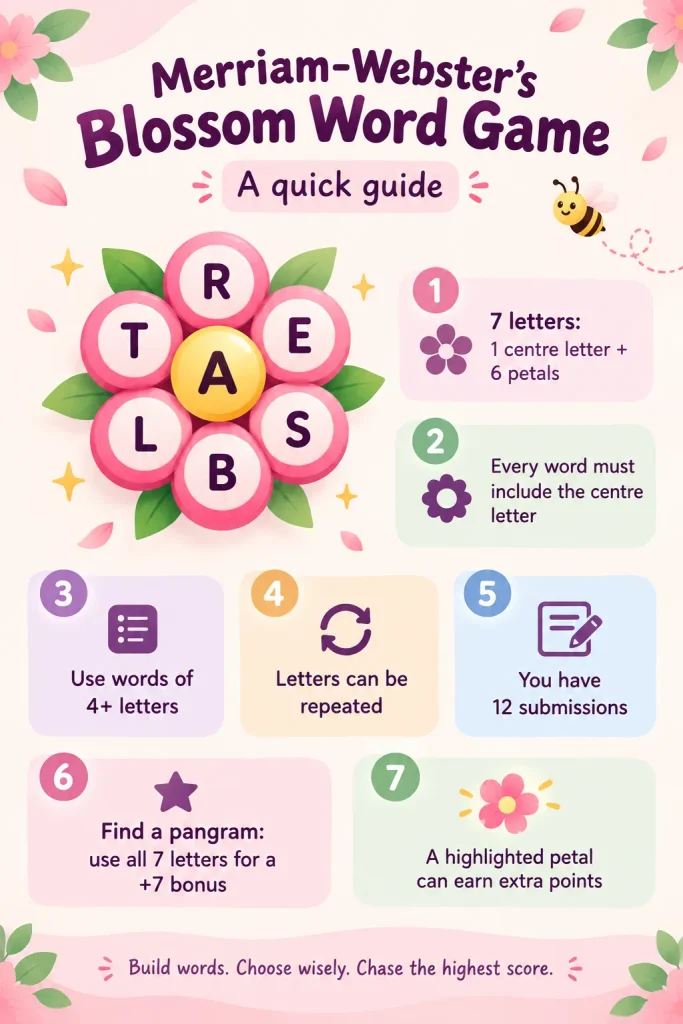
| Merriam-Webster Blossom | 12 words | 4 letters | Rotating bonus letter |
Tips for a higher score
- Find the pangram early. It is the biggest single score, and finding a few shorter words first often makes the pangram easier to spot.
- Search by word family. If “cast” works, check “casts,” “castle” and “caster” before scanning for new letters.
- Try common endings and beginnings. Add -ed, -er, -ing, -ly and -ness, or try re-, un-, de- and en- on a root you already found.
- Use the centre letter as an anchor. Write it at the start, the middle and the end of a word.
- Shuffle and step away. A fresh arrangement, or a short break, helps you spot words you missed.
Why Was My Word Rejected?
Check these six things:
- Does it include the centre letter?
- Does it have at least three letters?
- Does it use only the seven letters?
- Is it a name or place, like London?
- Does it have a hyphen or apostrophe?
- Is it an American spelling? Try the British form, such as colour instead of color.
Other Word Tools You Might Like
If you enjoy Blossom word game, a couple of related tools are worth knowing about. A Blossom word finder works the same puzzle from the other direction: you enter the seven letters you already have, and it shows you which words fit, which is handy when you are stuck rather than just starting out. A Spelling Bee solver does something similar for the NYT’s four-letter-minimum puzzle, for days when you want hints without spoiling the whole answer list.
If you’d rather play with American spellings, there’s a version for that at blossomwordsgame.com.
FAQs (Frequently Asked Questions)
Yes. This puzzle uses British English, so colour, centre and travelled all count.
Yes. There is no download and no account.
No. Submit as many as you can find.
A new puzzle appears every day, with a fresh centre letter and petal set.
Yes. It works in any modern mobile browser, with JavaScript turned on.
Blossom accepts shorter words, starting at three letters, and has no submission cap. The Spelling Bee starts at four letters.
Most flower and honeycomb word games cap you at a fixed number of answers and copy the four-letter minimum from the New York Times format. This one drops both limits — words can start at three letters and there’s no cap on how many you submit — and it uses British spellings by default, which most versions don’t offer.

Ijaz Khane
Creator, Blossom Word Game
Ijaz has spent 5 years building websites for other people. Blossom Word Game is his own. He built the tool that creates each day’s puzzle, picks the 31,000 words it can draw from, and checks every batch himself before it goes live.